
If you have spent years learning to code, or teaching others to, you probably know the odd feeling of being good at the work and unsure how to sell it. The technical side is learnable. The business side, pricing a job, scoping it, finding the next client, getting paid on time, is where many freelancers lose weeks. AI tools promise to speed all of that up, but most advice online stays vague. This review looks at one ebook that tries to be specific: a 286-page ebook for freelancers using AI, published by Be Ready Education.
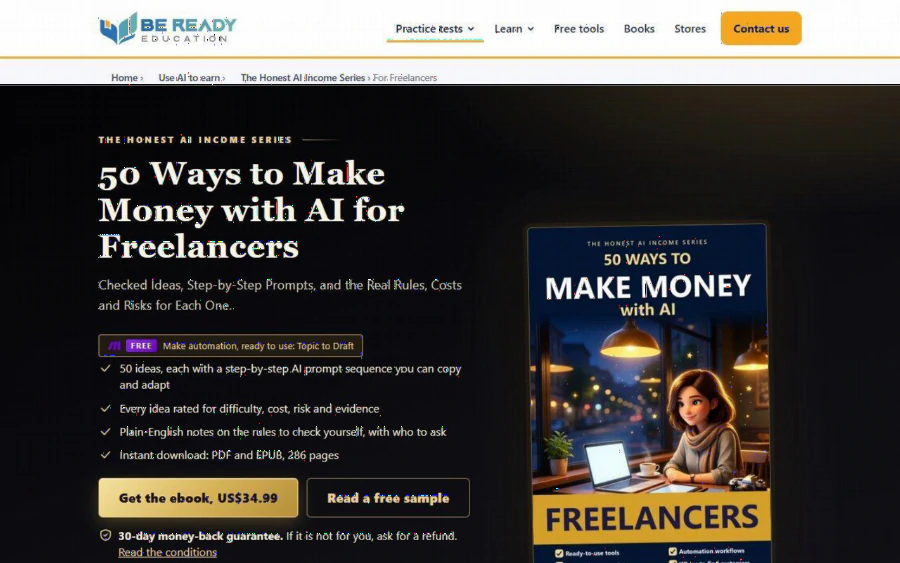
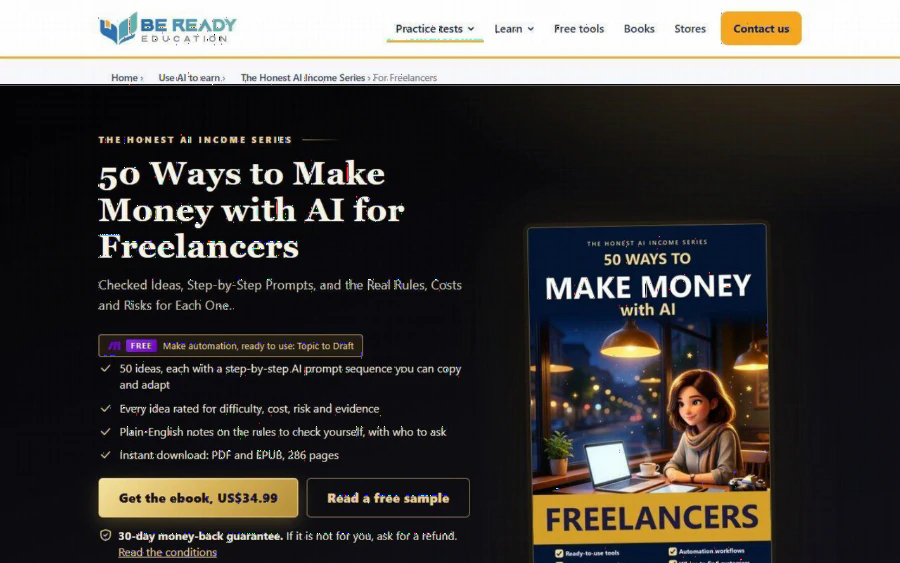
The product page for 50 Ways to Make Money with AI for Freelancers, showing the cover, the US$34.99 price and the 286-page PDF and EPUB format
What the book is, and what it is not
The title is "50 Ways to Make Money with AI for Freelancers," and the page places it in "The Honest AI Income Series." The subtitle promises "Checked Ideas, Step-by-Step Prompts, and the Real Rules, Costs and Risks for Each One." According to the product page it is an instant digital download in PDF and EPUB, with 6 x 9 inch pages and 286 pages in total. The price listed on the page is US$34.99 as a single payment, with no subscription, and the page mentions a 30-day money-back guarantee with conditions on a separate refund page.
It is also worth saying what it is not. The page states plainly: "We do not promise income or results." It describes itself as general information only, not financial, legal, tax or immigration advice. A page that says this up front deserves some credit, because the AI money niche is full of invented success stories. The book's own comparison box says typical guides "promise income and show invented success stories" and "hide the costs, the contracts and the platform rules." Whether the book fully lives up to that is something you can judge from the free sample, which the page offers as a PDF with no email or sign-up required.
How the 50 ideas are organized
The product page lists the ideas in seven parts, and the grouping is more useful than a flat list. Reading the part titles tells you a lot about the author's view of freelancing.
Part 1 is "Price it like a product" with nine ideas, such as a three-package menu built from your repeat jobs, a scope-and-exclusions one-pager, and priced revision-round add-ons. Part 2 covers finding clients outside the bidding sites, with seven ideas including past-client reactivation emails and a proposal win and loss log. Part 3 has nine ideas about selling what you already know, for example a client-onboarding questionnaire for one trade or a pricing calculator for your trade.
Part 4 lists ten services small businesses might pay for, such as meeting notes turned into action lists, help-centre articles from support tickets, and a rescue edit for AI-written drafts. Part 5 has five spreadsheet ideas for your own freelance business, including a late-invoice tracker and a "real hourly rate by client" sheet. Part 6 deals with contracts, data and platform rules in seven ideas, and Part 7 has three automation ideas that use n8n.
Notice how little of this is "let AI do your job for you." Much of it is about the unglamorous parts of running a one-person business: pricing, boundaries, records, contracts. For someone who learned a craft first and business second, that emphasis is sensible.
Four ratings on every idea
The most distinctive design choice is that each idea carries four ratings: difficulty, cost, risk and evidence. The companion page on the site, "Use AI to earn, honestly," explains them in plain terms. Difficulty is "the skills and time you need to get a first result." Cost is "what you have to spend before you earn anything." The page adds that the evidence rating means each idea states its sources and the date they were checked, and says so when reliable data is missing.
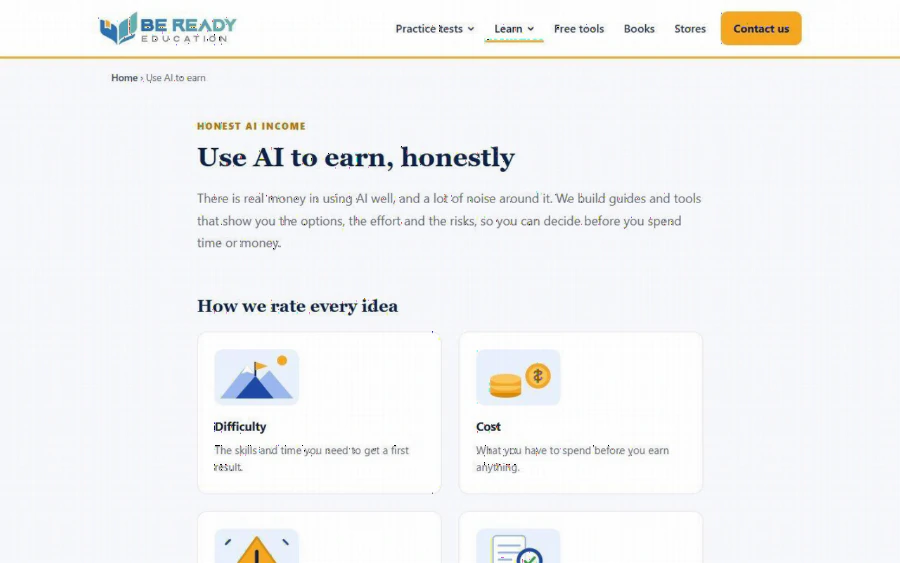
The Use AI to earn page on Be Ready Education, showing the Difficulty and Cost rating cards used to rate every idea
This matters more than it sounds. A freelancer deciding between "paid mini-audit in your specialty" and "monthly care plan for past clients" needs more than a cheerful description. They need to know which one needs a tool subscription, which one carries contract risk, and which one rests on a claim nobody has verified. The product page also notes that where a price appears, "it is a seller's asking price, not what anyone earns, and many ideas have no reliable income figure." That is an unusually candid sentence for this category.
Rules for the US, UK, Australia and Canada
Another practical detail: the page says the book includes plain-English notes on the rules to check yourself, with who to ask, and that it covers rules for self-employed people in the US, the UK, Australia and Canada. The ideas in Part 5 reflect this, with a record-keeping sheet that names ABN, 1099 and Self-Assessment. If you work with international clients, that coverage is relevant. If you live elsewhere, you will have to check local rules yourself, and the book's own disclaimer says platform terms, prices and laws change, so you should check official pages before acting.
Part 6 is probably the section a coding freelancer should read first. An AI-use clause checklist for client contracts, a client data handling one-pager and a "redact before AI" routine address a question many developers face now: what are you allowed to paste into an AI tool when the code or data belongs to a client? I cannot tell you what the book says inside those chapters beyond the titles, so treat this as a reason to read the sample, not as a verdict.
Strengths and limits
Strengths, based on what the product page shows:
- It is specific about format, length and price, so you know what you are buying.
- Every idea is rated on difficulty, cost, risk and evidence, which supports a decision before you spend time.
- It is written for freelancers rather than for everyone, and the same publisher offers separate books for students, side hustlers, people between jobs, small business owners, IT professionals, retirees, single parents and new immigrants, each listed at US$34.99.
- It includes a free sample and a refund window.
Limits to keep in mind:
- The page does not name an author. The FAQ says "AI helped draft it. A person checked the sources, edited the text and decided what went in." Some readers will want to know more about who stands behind the work; others will accept the disclosure as it is.
- No income is promised, so the book will not tell you how much you will earn. That is honest, but it also means you must do your own market testing.
- It is an ebook, not a course. There is no mention of live support or community.
- The page describes the book as written by an independent publisher, not affiliated with any tool or platform named in it, and notes that a free Make automation blueprint contains an affiliate link. The site's guide page also carries an affiliate disclosure. Read those notes before deciding how much weight to give any tool recommendation.
Who should read it, and who should skip it
This book fits a freelancer who already has a skill, such as web development, design, writing or tutoring, and who wants a structured menu of small offers rather than a get-rich pitch. It also suits someone who wants to tighten the business basics, like scoping, invoicing and contracts, while using AI as a helper. If you are a coding student with no clients yet, the Part 2 ideas on finding a first customer may help, though the book targets people who already have something to sell.
Skip it if you want a guaranteed income plan, a course with live feedback, or deep technical training in a programming language. It is a business and workflow guide, not a programming text.
A simple way to start
Start with the free sample before paying anything. The page says it covers the cover, contents, welcome pages and first ideas. While reading, pick one idea from Part 1 and one from Part 6, since pricing and contracts are where small mistakes cost the most. Then compare the four ratings against your own budget and risk tolerance. If the sample matches how you think, the US$34.99 ebook has a 30-day money-back guarantee, with the conditions on the refund page.
Be Ready Education is better known for practice exams, and the same publisher has an index of independent practice tests for vendor certifications for people who prefer to build credentials alongside freelance work. That is a separate product, and nothing in this review depends on it.
The sensible takeaway is modest. A freelancer does not need fifty new ideas; they need two or three that fit their skills, their market and their tolerance for risk. A book that rates its ideas honestly, and says when evidence is thin, gives you a better chance of picking those few well.